

Is Google Zero the End of the Road for Small Businesses?
Is Google Zero the End of the Road for Small Businesses?
Google used to be the phone book. You looked something up, it gave you a list, and you went and knocked on doors. Now it’s more like the friend who answers for you. You ask where to find a good candle, and before anyone gets a word in, it has picked three, compared them, and summarized the reviews. Nice for the person asking. Less nice if you’re the shop nobody got to knock on.
That shift has a name: Google Zero. If your traffic has been sliding and you’ve been telling yourself it’s seasonal, it might be worth a second look.
What Google Zero means
Google Zero is the point where Google gives people enough information on the results page that they never need to click through to a website. It might be a short answer, a map, a review summary, or an AI-generated overview.
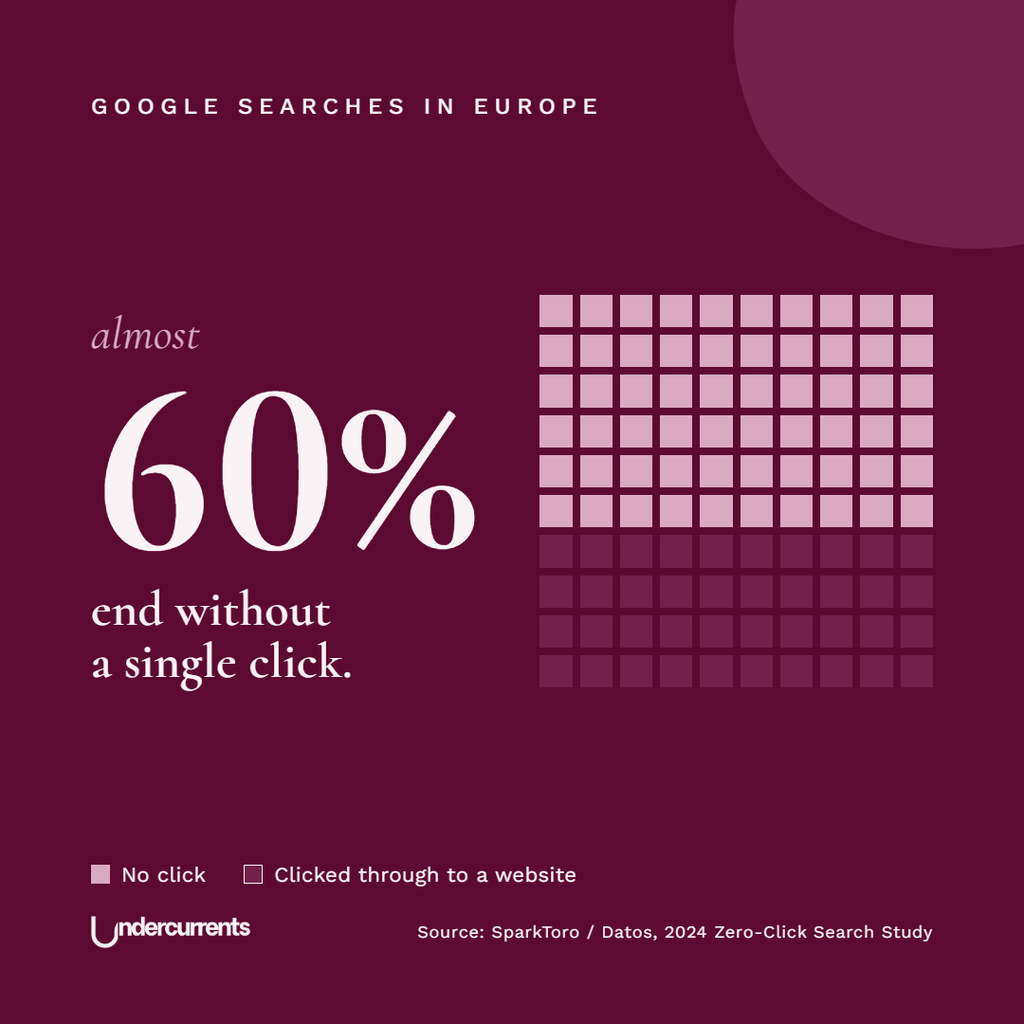
We are not at the point where Google sends no traffic at all. But we are already far enough along that many small businesses are feeling the change. In Europe, almost 60% of Google searches already end without a click, and AI answers have made that even more obvious.
The important part is not the label. It is what happens next: fewer easy visits, fewer casual readers, and more pressure on the pages and channels you actually control.
Who loses first
The first businesses to feel this are usually the ones relying on broad informational content.
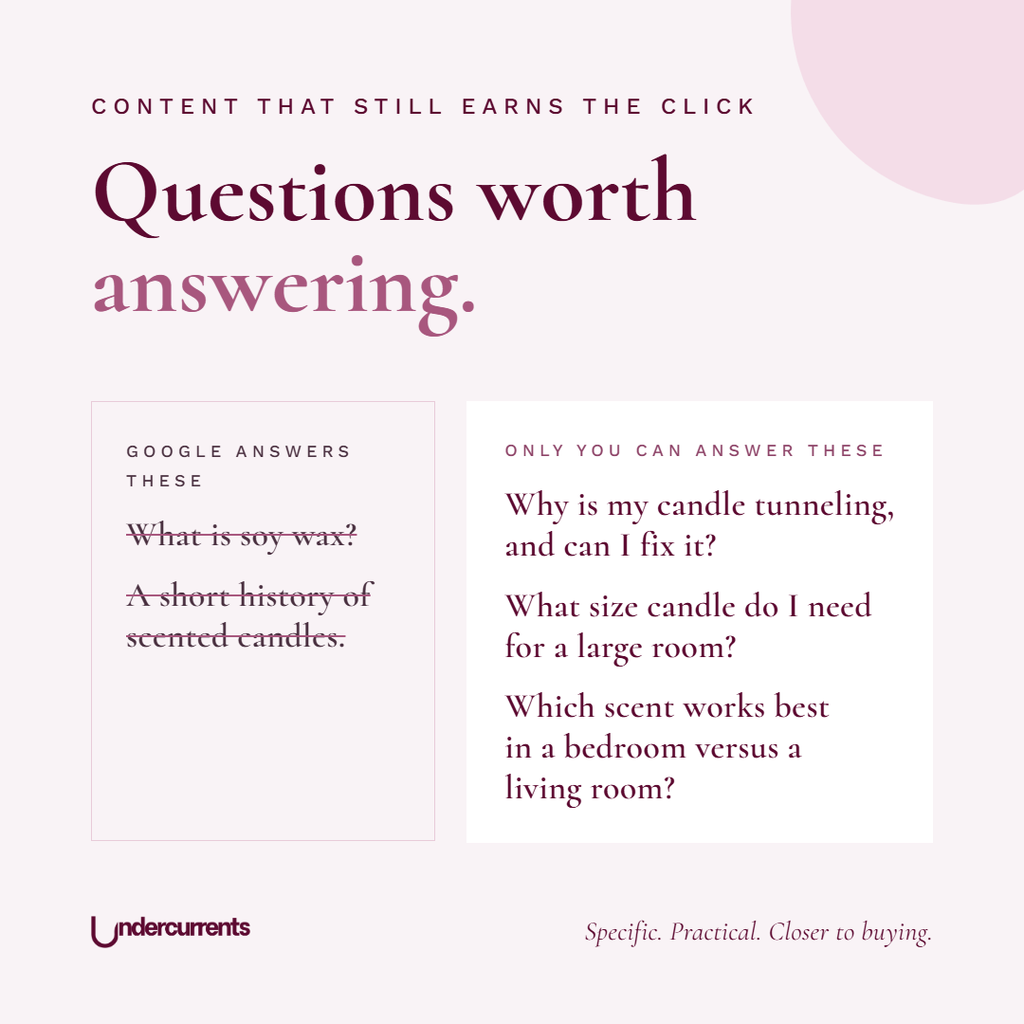
A small candle brand selling exclusively online for instance. For years, it might have published articles like “What is soy wax?” or “A short history of scented candles.” Those posts used to bring in a steady trickle of visitors. Now Google can answer both questions in a sentence or two, and the traffic disappears before the shopper ever reaches the site. The job those articles were doing simply got taken over.
That does not mean content is useless. It means the content has to do a different job.
The questions worth answering
The questions worth answering now are the ones Google cannot settle in a sentence, because the answer depends on someone’s situation.
For the candle brand, that might be:
1. Why is my candle tunneling, and can I fix it?
2. What size candle do I need for a large room?
3. Which scent works best in a bedroom versus a living room?
Those are specific. They are practical. And they are asked by people who are much closer to buying.
You will not always find those questions in a keyword tool. Often, you find them by listening to customers, reading emails, checking reviews, and noticing the things people ask on the phone or in person.
Your product page is doing more work now
If fewer people arrive, each visit has to carry more.
That is why I always ask: have you ever bought something from your own shop? Actually gone through the whole thing as a customer, on your phone, start to finish?
Most businesses have not. And when they do, the gaps show up quickly.
The page may give the product a lovely name, but never say what it actually smells like. It may promise long-lasting performance without saying how many hours that means. It may show a beautiful jar, but never explain the wax, wick, vessel, or whether the container has a second life after the candle is finished.
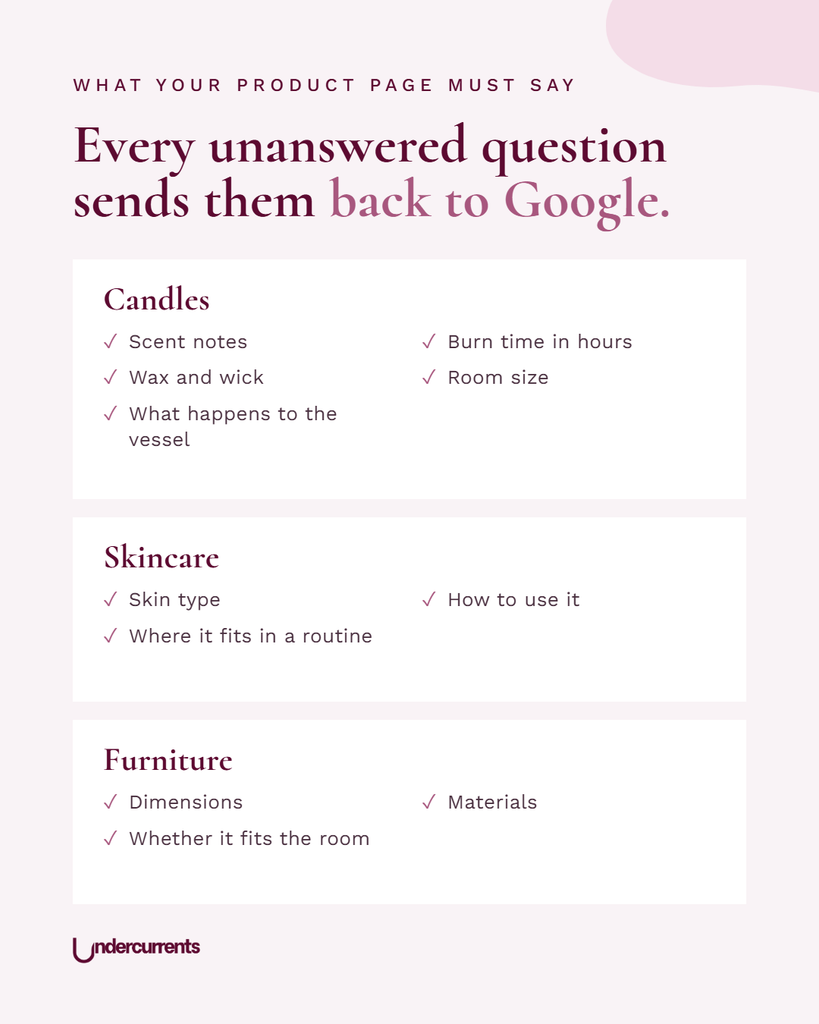
For skincare, this means skin type, usage guidance, and how the product fits into a routine. For furniture, it means dimensions, materials, and whether the piece actually fits the room. For candles, it means scent notes, burn time, wax type, room size, and what happens to the vessel after use.
Every unanswered question sends someone back to Google. And now Google has a very good chance of answering them without sending that person back to you.
Proof beats polish
When people cannot touch the product, they look for evidence that someone else did.
Reviews matter more than another beautifully written brand paragraph, especially for anything personal or expensive. Ask for them after purchase, and ask for something specific: how the scent filled the room, whether it burned evenly, whether they would buy it again. Then reply. People notice when there is a real person on the other end.
The same goes for images. A real photo of the product in a real home does more than a stock shot of a candle next to a eucalyptus branch. Behind-the-scenes clips, founder notes, and your own expertise are harder to copy than a generic category summary.
The boring job that helps: alt text
There are also a few practical things worth cleaning up, especially if you have a lot of product images.
One of them is alt text, the short written description attached to an image. It helps screen readers, and it also helps search engines understand what the image shows. Most small shops either leave it blank or fill it with something vague and repetitive.
That is worth fixing because it helps both accessibility and visibility. If you use tools to speed it up, make sure the output actually describes the image instead of repeating the product title in a different outfit.
A few tools make it bearable, most of them with a free tier:
WordPress
1. Auto Alt Text: the plugin is free, and you connect your own OpenAI, Claude, Gemini or Azure account, so you pay the AI provider directly per image. It also has a no-AI option that copies the page or image title, which is free but never actually looks at the picture.
2. Alt Magic: 50 free credits every month, refreshed on the 1st. Works with WooCommerce and plays nicely with Yoast and Rank Math.
3. Rank Math: if you already use it, its image settings can fill in missing alt text from a template built with variables, like the product title. Two catches: it only fills the gaps as the page loads, without saving anything to your media library, and it only covers images inside your content.
Shopify
1. SEO HERO AI Alt Text Generator: 100 free alt texts to test, with keyword and prompt controls.
2. AltKing: free plan with template-based bulk generation, handy for catalogs with lots of variants.
3. Rocket AI Alt Text Generator: 500 images free as a one-time bonus, then $1 per 50.
4. AltText.ai: your first 25 images are free, then pay as you go. It reads your product title, brand and description.
Whatever you pick, read what it writes before you hit publish. A template that produces “Amber Candle Home Fragrance Amber” three hundred times is technically alt text. It just doesn’t help a blind shopper, and it tells Google nothing your product title hadn’t already said.
If you have a physical location
If you have a shop, studio, or showroom, your Google Business Profile is one of the few places where zero-click works in your favor.
People can see your hours, photos, and reviews, then call, book, or ask for directions without ever touching your website. That is fine. They are still coming to you.
Keep the profile current. Add photos regularly. Fill in the services. Answer the questions people leave there. An active profile looks like an open shop, not an abandoned one. More about how to do it here.
Build something you own
Search traffic was always borrowed. What you keep is the relationship you build once someone finds you.
Capture email early with something genuinely useful in exchange: a scent guide, a care guide, a short quiz, a product matcher. Then give people a reason to come back. Seasonal picks, a small loyalty program, or a recurring email people actually look forward to will do more for you than another round of generic content.
You do not need to be everywhere. You need to be remembered by name, because someone typing your brand into Google is the visit Google is least likely to take away from you.
What to stop doing
Stop publishing just to feel productive.
Stop writing articles whose whole point fits in one sentence.
Stop treating search as the only way anyone will ever find you.
The lesson behind the traffic drop
Google Zero is unlikely to close your business. It will, however, show you exactly how much of your growth depended on someone else’s goodwill.
The ones that come through this will understand their customers, answer the questions that stand between them and a purchase, and make the decision easy once they arrive.