
Welcome Emails: The First Automation You Should Build
You did it. Someone found your shop, liked what they saw, and gave you their email.
That is not a small thing. It means they are interested right now, more than they will be again without effort.
What happens next is either the start of a relationship or the beginning of being ignored.
Most small brands either send one generic “thanks for subscribing” email and stop there, or they postpone automation entirely because it feels like something to “set up properly later.” Later rarely comes. And in the meantime, the people who were ready to hear from you forget you exist.
The upside: this is one of the easiest systems you can put in place, and one of the few that works immediately. If you have an afternoon, you can have it live by tomorrow.
Why this one first?
If you only automate one thing, make it your welcome sequence.
These emails consistently get the highest open rates you will ever see, often two to four times higher than your regular campaigns. Not because they are better written, but because of timing. People expect them. They are paying attention.
That window closes quickly. This is how you use it.
What a welcome sequence actually looks like
Just three emails that each do one job well.
Email 1, send immediately
This is your highest-attention moment. Do not waste it.
Thank them. Set expectations about what you will send and how often. Deliver what you promised, whether that is a discount, a guide, or early access, clearly and without friction.
Keep it tight. One warm paragraph, one clear action.
Subject line note: skip first-name personalisation unless your setup handles it cleanly. A subject line that reflects intent (“Welcome, here is your 10%”) will outperform “Hi [Name]” because it matches what they came for.
Email 2, send 2 to 3 days later
This is where you earn your place in their inbox.
You do not need your full story. You need one reason to care: why you started, what you care about, or what you refuse to compromise on. Make it specific enough that it could not belong to another brand.
If you have a best-seller, introduce it here. One is enough. Add a short, real customer sentence if you have one. Social proof works best when it feels unpolished.
Email 3, send 5 to 7 days later
Now you ask.
By this point, they have had time to browse. If they have not purchased, give them a reason to act. If you offered a discount, remind them and add a real deadline. Real matters. False urgency erodes trust faster than no urgency at all.
If they already bought, suppress this email. Most platforms handle this automatically, but it is worth checking. Offering a discount right after a full-price purchase is an easy way to create friction you do not need.
The mistake that kills it: Going straight to the sell.
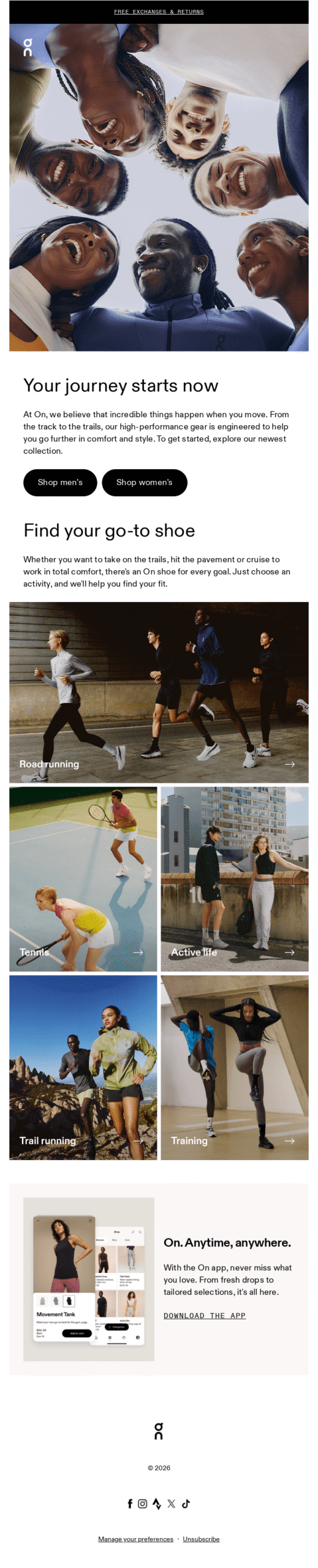
Example of a welcome email that focuses on product discovery, category navigation, and brand immersion rather than a plain “thanks for signing up” message.
This email is strong because it does a few things at once:
1. It leads with a clear brand mood and visual identity.
2. It gives immediate paths to browse by category, instead of forcing people to hunt.
3. It includes a secondary engagement point with the app, which extends the relationship beyond the inbox.
4. It is polished and editorial, which is especially relevant for a premium or high-design brand.
A note on luxury and high-end brands
If you are selling in a luxury or high-end niche, the standard playbook needs adjusting. Heavy pop-ups, aggressive discounts, and countdown timers can undercut the very positioning you have worked to build.
The quieter approach tends to work better here. A minimal footer form with understated copy, a subtle announcement bar, no urgency language. Focus on exclusivity and access rather than price reduction: early access, invitations, new drops. The goal is to feel like an invitation, not a sales pitch. If you do use a pop-up, make it rare, well-timed, and simple, more like a discreet card than a loud overlay.
What about AI?
This is one area that has genuinely changed things for small business owners.
If writing has been the reason you have not set this up yet, that barrier is lower than it used to be. Tools like ChatGPT, Claude, or the AI writing features built into platforms like Mailchimp and Klaviyo can get you to a working first draft in minutes.
The catch is that AI copy tends to sound like AI copy until you edit it.
The “good enough” standard
Your welcome sequence does not need to be perfect. It needs to exist, and it needs to sound like you.
Three emails. One job each.
Set it live, let it run, and revisit it once you have real data: opens, clicks, purchases. That is when you optimise. Until then, done beats perfect. And it beats nothing by a mile.