

Something that comes up all the time when I talk to small business owners and ecommerce store founders, usually right after the endless WordPress vs. Shopify debate, is email marketing. More specifically, it is the frustration of following popular guides online to the letter and not getting the results they promised.
And honestly, I get it. That is also how I started.
Most welcome email advice sounds reasonable enough. Send 3 to 7 emails over 1 to 2 weeks. Mix in a brand story, education, and product highlights. Drop in a discount code. Keep it consistent, automated, and “industry best practices.”
And sure, that can be a decent starting point. It gives you something running in the background. But I do not think the real question, as I am often asked, is how many emails should be in the sequence. The real question is what the subscriber actually needs from you, and what your business is trying to do at that specific stage.
Because once you try to walk in your target customer’s shoes, the whole conversation changes.
The Problem with Generic Welcome Advice
A lot of welcome sequence advice online is built to be broadly useful, which is fine. The issue is that broadly useful often becomes too generic to be strategic.
A small brand selling handmade earrings does not need the exact same welcome flow as a tea brand, a skincare brand, a furniture brand, or a supplement brand. A first-time subscriber for one business may need reassurance and trust. For another, they may need deeper education. For another, they may simply need a clear, low-friction path to purchase.
Yet most guides reduce all of that to sequence length and a handful of email types, as if the order and number of messages are the strategy itself. They are not.
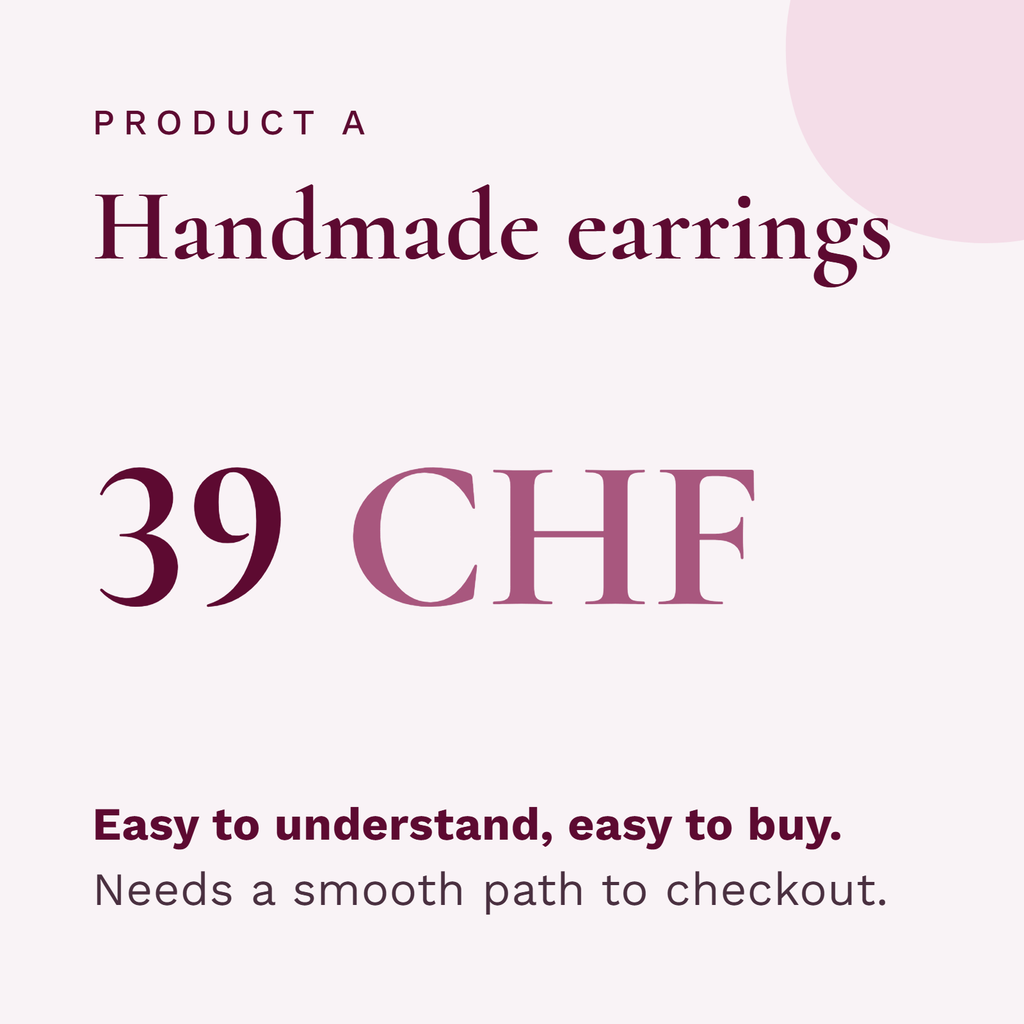
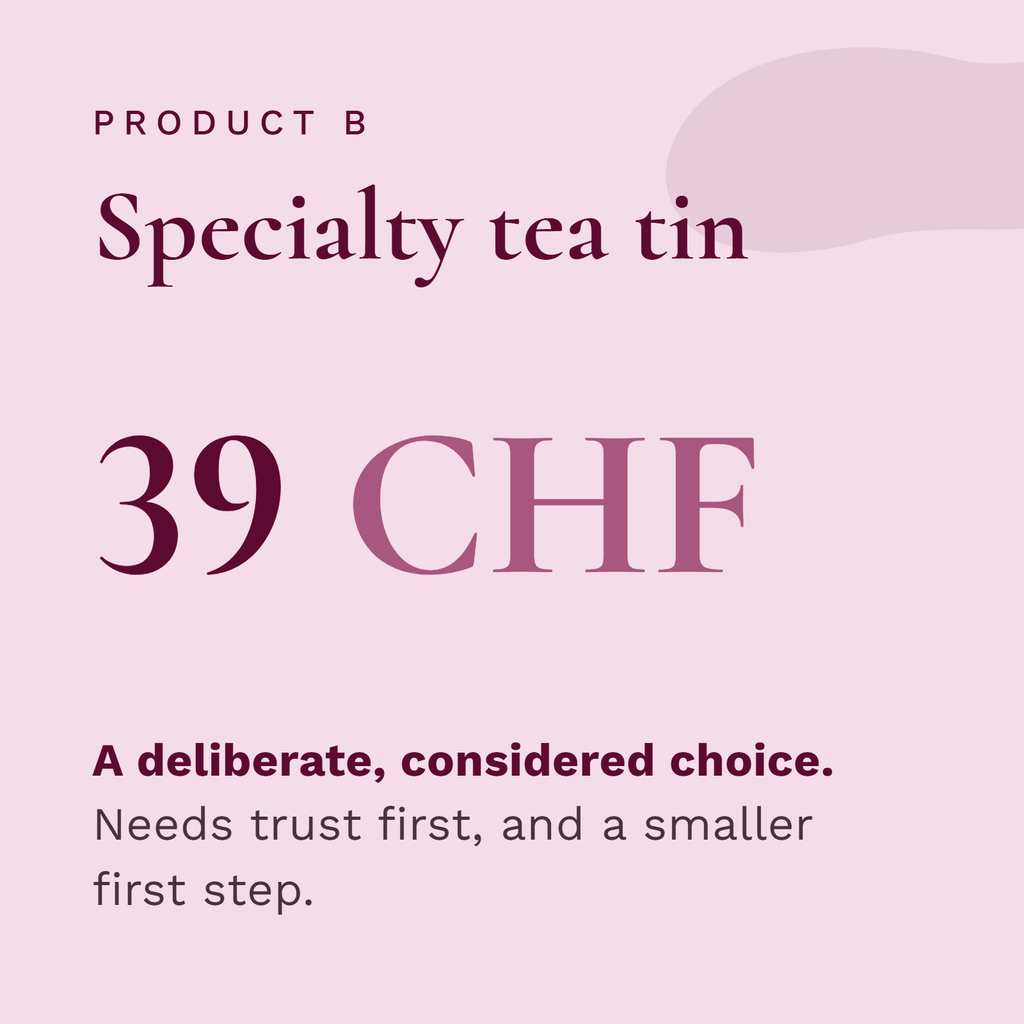
To make this concrete, let’s look at two very different products at the exact same price point: a pair of handmade earrings and a specialty tea tin, both sold for 39 CHF. Same price point, but very different buying logic.
Sequence Length Is Not the Strategy
A short sequence can work beautifully for a product that is easy to understand and easy to buy. Take a pair of handmade earrings, for example. In many cases, the first email should do exactly what the subscriber signed up for. It should welcome them, deliver the discount or free shipping offer if that was promised, include a clear CTA to redeem it, and offer support in the closing, which is still missing far too often.
Email two should not be the usual tired reminder to use the discount with fake urgency. If done well, this is where the founder can share a little more about herself, the process behind the product, and the brand’s real USPs. For handmade jewelry, that might mean originality of design, materials, craftsmanship, or features like waterproof or long-wear finishes.
This is also a good place to remind the subscriber of their offer in a more elegant way, maybe by showing products they have already been browsing or a small collection grid. The CTA should still carry the dynamic coupon, so the path to purchase remains frictionless.
This is also the email where reassurance belongs. Safe payment, tracked delivery, free returns, and hassle-free service should not be hidden in the fine print. They should be easy to spot, not buried like embarrassing family secrets, ideally near the top of the footer, because trust is part of the sale.
Email three can be a final, gentle reminder of the discount if there has been no purchase. After that, I do not think the answer is always to keep sending more emails or adding another incentive. At that point, move the subscriber into a separate nurturing or newsletter segment instead of stretching the sequence just to keep talking.
When Education Becomes the Better Move
Now look at the specialty tea tin. Spending 39 CHF on tea is a deliberate choice. If you treat that buyer like an impulse shopper, you miss the point.
A short sequence can work here too, but the angle is slightly different. Email one should still welcome the subscriber, deliver the promised discount or free shipping offer, include a clear CTA to redeem it, and offer support in the closing. But before the CTA, I would add a stronger layer of product reassurance.
With something edible, and especially something with a price tag, the subscriber needs more than a pretty product shot. They need a reason to trust what they are buying. That means bringing the USPs forward right away: organic, no pesticides, harvested in XYZ, and whatever else makes the product worth the price. I would also include a small collection grid, ideally featuring bestsellers, because if someone is already interested enough to sign up, showing them the products that perform best makes the next step easier.
Why? Because when the product is something you eat or drink, the buyer is not just purchasing taste, they are purchasing confidence. They want to know where it came from, how it was grown, and why it deserves a place in their kitchen. That is why the first email should not only welcome and convert, but also justify the choice.
Email two can then go deeper into origin, brewing, flavor notes, ritual, or use case, depending on the brand. The point is not to overwhelm, but to give the subscriber enough context to feel good about the purchase. Emails three and four can build on that with a customer favorite or a simple brewing guide, followed by a gentle reminder of the offer.
Beyond email four, I would usually avoid adding more urgency unless there is a genuinely time-sensitive reason to buy now, like a launch window, a limited harvest, or an expiring offer. If the person still has not converted by then, the issue is usually not that you need to push harder. It is more likely that they need a lower-friction entry point or a different path entirely.
A discounted sample or discovery format will often do more than another urgency email. Tea is one of those products where trial lowers risk, especially if the full-price tin feels like a bigger commitment for a first purchase. A sample gives the subscriber a way to experience the quality before they make a bigger decision.
That is why I lean toward a smaller starter size, a sample set, or a tasting bundle rather than more pressure. You can then move the subscriber into a separate nurture path and keep educating them over time with brewing tips, origin content, or product education.
Instead of asking whether you need more urgency, the better question is: what can you do to make the first purchase feel easier to say yes to, or to build long-term trust with the subscriber?
The Unpopular Truth About Subscriber Behavior
And now comes the unpopular opinion. Drum roll, please: what the subscriber needs is not always what you want them to need.
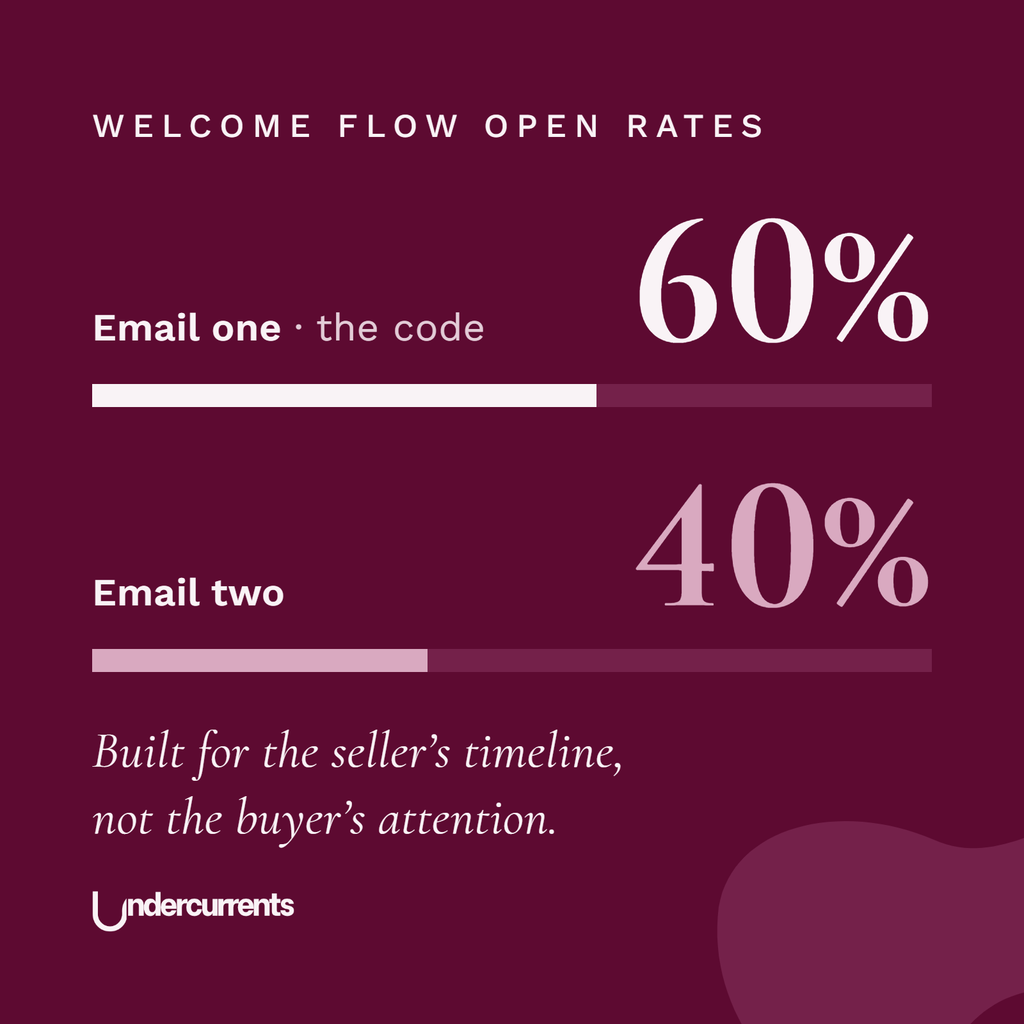
A big share of your subscribers check out after email one. Look at typical welcome flow open rates: the first email, the one carrying the discount, often opens at 60% or more, because people go looking for the code they were promised. By email two, that usually drops to around 40%. That is not necessarily because email two is bad. It is because the sequence is built for the seller’s timeline rather than the buyer’s peak attention window.
And yes, you spent weeks building a pristine five-email welcome series. You agonized over subject lines. You split-tested send times. You even wrote an “our story” essay you were entirely too proud of. I know the feeling.
Then they grabbed the code, bought, and immediately fluffed off into the digital void. You built a grand welcome mat; they just wanted the product cheaper. Cue the tiny violins. You think that is a tragedy? I call it a completed transaction. They came for a discount, they got it, and they bought. Your welcome flow did its job, even if nobody read the essay.
And the ones who grabbed the code and never used it? That is a different problem, and more emails will rarely solve it. More on that below.
The job of the welcome sequence is not just to nurture in some vague marketing sense. It is to meet the subscriber where they actually are.
The High Cost of Forcing the Sale
This is where a lot of brands make a very expensive mistake. A new subscriber opens the first emails and clicks a few links, and the brand reads that interest as readiness to buy. So the answer becomes more pressure. More urgency. More “last chance” reminders. More discount chasing.
But if the person is not ready, that is not persuasion. That is just noise.
You can usually see what happens next in the data. The same subscriber who was opening and clicking at first starts to fade. Opens flatten, clicks drop, and eventually they stop paying attention altogether. If you keep pushing too hard, they will not just ignore you. They will start training themselves to skip your emails before they even open them.
Another sign that you are forcing too much too soon is the difference between how people respond to your automated flows and how they respond to your newsletters. Commercial flows can still perform because they are expected and contextually relevant. But newsletters are a different test. If people know every single email is trying to sell, engagement drops fast.
If you are still not convinced, ask yourself how quick you are to answer someone who only ever contacts you when they need something from you.
Playing the Long Game
That is because brands that win at email do more than sell products. They give subscribers a reason to stay interested even when they are not actively shopping.
It is usually something useful or interesting, sometimes even outside the strict boundaries of the niche. Home and decor brands sharing travel itineraries and design inspiration. Bookstores sharing seasonal mocktail recipes to go with a weekend read. Specialty tea brands discussing mindfulness and morning rituals.
And that matters. Because no matter how good your product is, people are incredibly quick to tune out the moment they feel like every single interaction is a sales ask.
Before You Change Your Welcome Flow, Do This
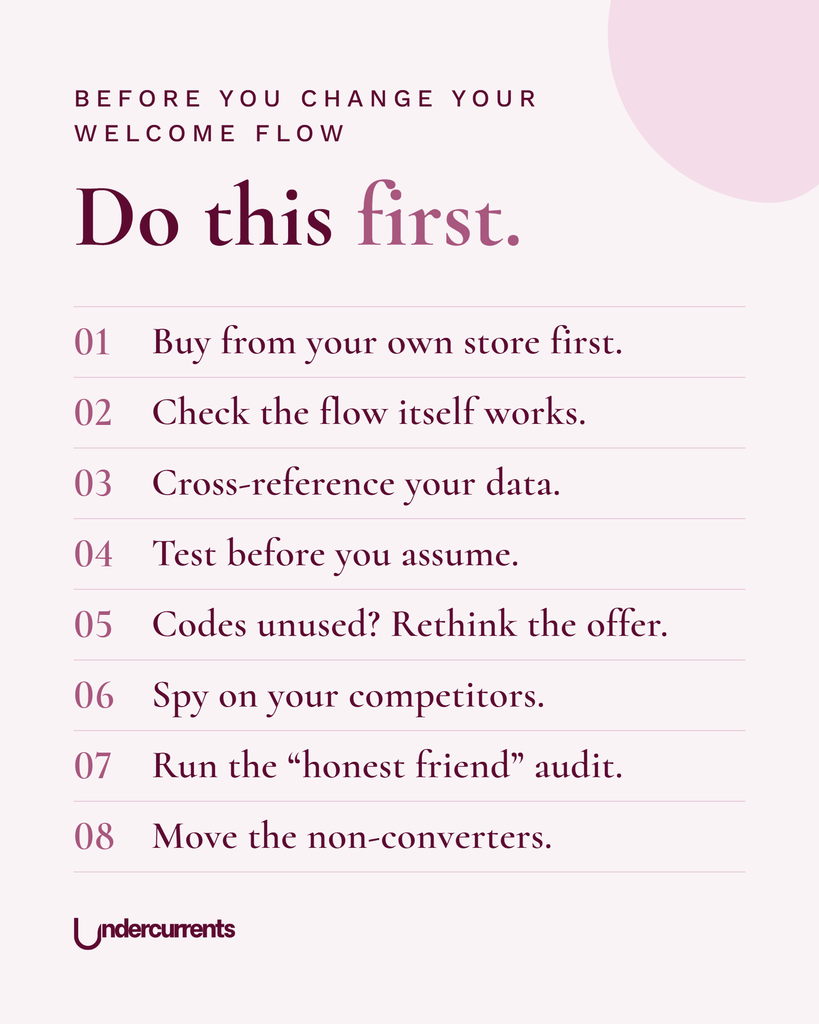
It is tempting to open your email service provider and start rewriting your copy immediately. But before you change a single word of your welcome flow, you need to isolate where the breakdown is actually happening.
Buy from your own store first.
Sign up with a personal email address and go through the whole journey as a customer: the pop-up, the welcome email, the code, the checkout. You would be surprised how many founders have never done it, and how much it reveals.
Check whether the problem is actually the flow itself.
Does the dynamic coupon work as intended? How long is the redemption path?
Cross-reference your data.
Look at your email platform, your ecommerce platform, and Google Analytics together. If the technical side is fine, the numbers will usually tell you where people are dropping off.
Test before you assume.
A/B test the new emails. Test the offer. Test the CTA. Test the timing. Do not guess when you can measure.
If people are not redeeming the discount, ask a better question.
Is the offer wrong? Would a gift with purchase or free shipping work better than another percentage off?
Spy on your competitors.
If everyone in your category is offering the same thing, maybe the problem is not your welcome flow. Maybe the problem is that your offer looks exactly like everyone else’s.
Run the “honest friend” audit.
We all have that one friend or family member who doesn’t sugarcoat things. Hand them your phone, ask them to sign up, and demand their completely unfiltered opinion. Is the text too boring? Is the pop-up annoying? Listen to them; they represent your real customers.
Move the non-converters.
If they are not ready, stop forcing them through the same sequence. Put them into a segment for engaged non-buyers or an editorial nurture flow instead.
Stop Sending Emails for the Sake of It
So before you add another email, another code, or another “last chance,” go back to where this started and put yourself in your customer’s shoes. The earring buyer may just want a smooth path to checkout. The tea buyer may need a reason to trust you first, and a smaller first step. Neither of them needs more noise.